
Why Humans Draw
A discussion on the philosophy of why humans draw pictures, even when it doesn't become commercially rewarded.

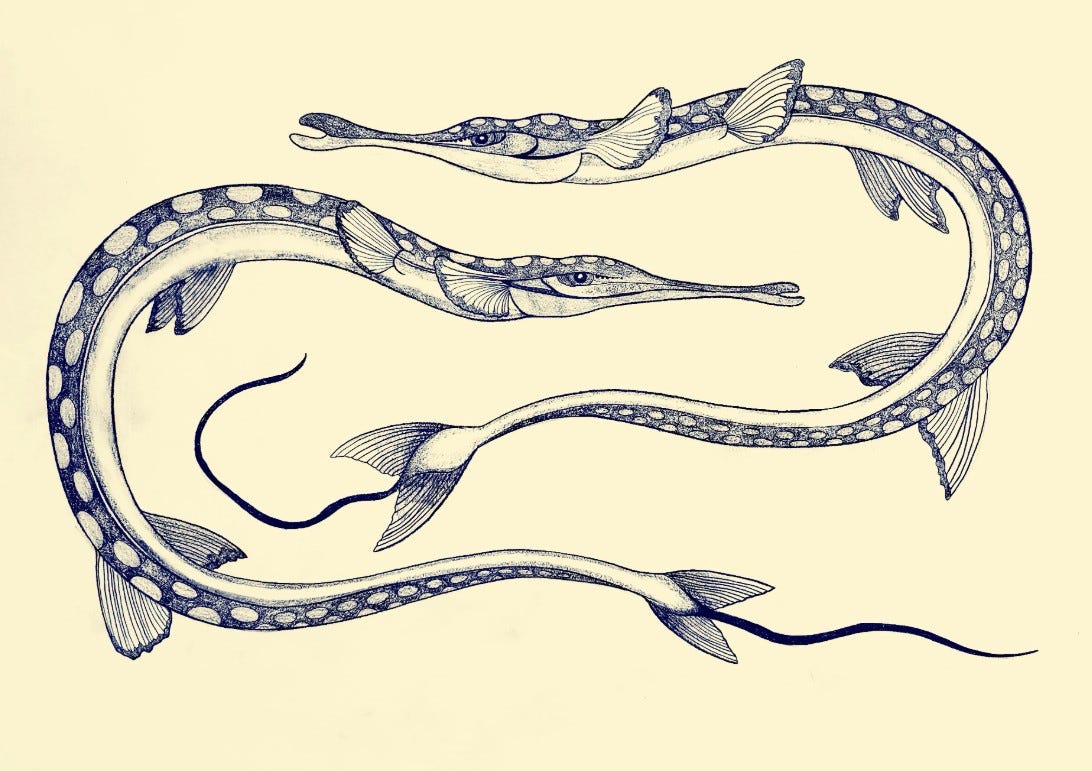
If drawing were merely a way of earning a living, we would expect it to disappear wherever there was no market. Yet every known human culture makes images. Children draw before they can write. Prisoners scratch figures into walls. Sailors carve scrimshaw. Medieval monks filled the margins of manuscripts with strange beasts that no patron requested. People doodle absent-mindedly during meetings. Something deeper is happening.
One answer is that drawing is a form of thinking.
Language is linear. It unfolds one word after another. An image exists all at once. When you draw a fish, you are not simply recording the fish - you are discovering which aspects make it that fish. Is the curve of the back more important than the eye? Does its movement matter more than its anatomy? Drawing forces the mind to negotiate reality in a way speech often cannot.
This may explain why naturalists, engineers, anatomists and archaeologists still sketch despite having cameras. The act of drawing isn’t just copying; it is understanding.
But philosophy pushes us further.
Perhaps humans draw because consciousness longs to externalise itself. Thoughts are invisible. The moment you make a mark, something private becomes public - even if no one ever sees it. The image stands outside you. It almost acquires an independent existence.
In that sense, every drawing is a negotiation between inner and outer worlds.
Phenomenologists like Maurice Merleau-Ponty argued that perception isn’t passive reception but an active relationship with the world. The artist doesn’t merely observe nature; artist and subject participate in one another. When drawing a tree, your hand follows rhythms already present within the tree’s form. The drawing becomes less an invention than a conversation.
That sounds abstract until you’ve experienced it. Many artists report that they stop feeling like they’re “making” the drawing and instead feel they’re uncovering something already there.
Another possibility is evolutionary.
Humans are pattern-seeking animals. Our survival depended on recognising shapes: a footprint, the curve of a predator’s back, edible plants. Drawing may be an extension of this capacity - a way of rehearsing patterns outside immediate survival. Once survival pressures eased, pattern recognition became decoration, symbolism and eventually art.
Yet this explanation feels incomplete.
Evolution may explain how the capacity emerged, but not why people spend thousands of unpaid hours illustrating jellyfish, painting mountains or carving birds into driftwood.
The behaviour often exceeds utility.
This is where I find the idea of play compelling.
The Dutch historian Johan Huizinga argued in Homo Ludens that culture itself grows from play. Play isn’t frivolous; it’s the space where imagination explores possibilities without immediate necessity.
Drawing resembles play because it asks, “What if?”
What if this line became a wave?
What if this creature existed?
What if I could show how the sea feels rather than how it looks?
The drawing isn’t solving a practical problem. It’s exploring potential worlds.
Religious traditions offer another perspective.
In many cultures, images weren’t originally “art” at all. They were participation.
Painting a bison on a cave wall wasn’t necessarily representing the animal; it may have been entering into relationship with it. An icon in Orthodox Christianity isn’t simply a picture of a saint but a window into divine presence. Australian Aboriginal paintings often encode ancestral journeys that remain active realities.
In these contexts, making images is less about aesthetics than ontology.
The picture changes the relationship between human and world.
If rivers, serpents, fish and tides possess agency rather than merely existing as objects, then drawing them isn’t simply depiction.
It’s hospitality.
The artist makes room for another being to appear.
This differs subtly from saying the drawing contains a spirit. Rather, the act of sustained attention is itself relational. To draw a crab for three hours is to notice the proportions of its shell, the hesitation of its legs, the peculiar engineering of its joints. Whether or not one believes the crab possesses personhood, drawing has already transformed one’s relationship to it.
Perhaps that’s why commercial success feels secondary for many artists.
If drawing is fundamentally a way of relating - to memory, landscape, animals, ideas or the sacred - then selling the result is almost incidental. Payment may sustain the practice, but it doesn’t generate the impulse.
A final thought fascinates me.
Humans don’t only draw beautiful things. They draw monsters.
Dragons, sea serpents, angels, impossible architectures, beings no one has seen. Why?
Perhaps because imagination is not the opposite of reality. It is reality’s horizon.
Imaginary creatures often reveal truths ordinary observation cannot. A sea serpent can embody the unknowable ocean better than an accurate drawing of a whale. Mythical images become philosophical tools.
So maybe the deepest answer is surprisingly simple:
Humans draw because existence overflows language.
There are experiences - a storm at sea, grief, wonder, the feeling of watching sunlight move through kelp - that words can circle but never quite capture. A drawing doesn’t explain those experiences either, but it can share them.
In that sense, drawing is neither decoration nor communication alone.
It is a way of participating in reality itself.